
Trapping a skunk is mostly about not getting sprayed, and that comes down to keeping the animal calm. Skunks are not aggressive, but a trapped skunk is a frightened skunk, and a frightened skunk sprays. Here is how I set traps, bait them, cover them, and handle the whole thing without ending up smelling like it.
The Short Version
- Cover the trap completely. A covered trap looks like a safe dark den, not a cage.
- Place traps on travel routes, along fences, foundations, and vegetation edges.
- Use strong-smelling bait like canned fish, cat food, or peanut butter.
- Check traps at first light. Skunks are nocturnal, and you don’t want one sitting in a trap all day.
- Know your local laws. Trapping and relocation are regulated in most places.
Legal Considerations First
Before you set a single trap, check your state’s rules. Skunks are classified differently from state to state. Some treat them as furbearers with seasons and licenses. Others treat them as nuisance wildlife you can trap year-round under a permit. A few restrict or ban live trapping and relocation of skunks entirely because they are a rabies vector.
Relocation is the heavily regulated part. Moving a skunk stresses the animal and can spread disease into a new area, so many states require trapped skunks to be euthanized rather than relocated, and some require a licensed operator to do it. Inhumane methods like drowning are illegal in most places.
Never transport a trapped skunk in an open truck bed or an unsecured vehicle. Stress makes them spray, and a spraying skunk in a moving vehicle is a genuine hazard. Use a covered, ventilated container secured inside a closed vehicle.
Choosing the Right Trap
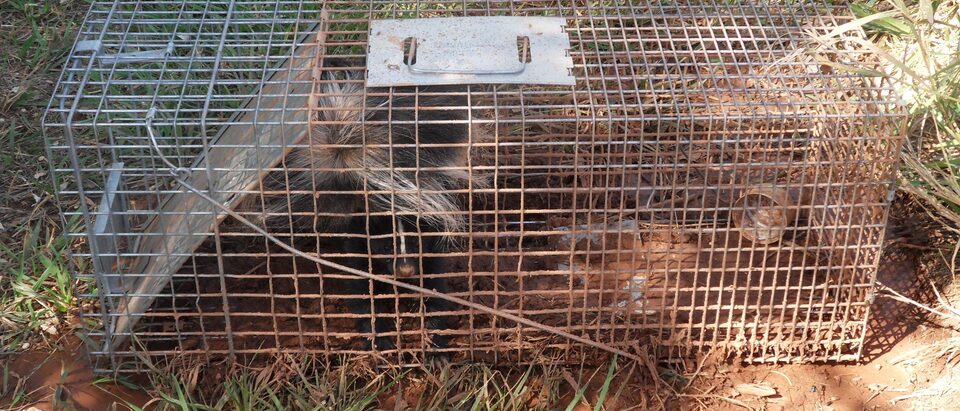
The standard skunk trap is a wire mesh cage about 10 by 12 by 32 inches or larger. That gives a full-grown skunk room to stand and turn around. Small squirrel or rat traps won’t fit one.
Use 12-gauge or 14-gauge galvanized wire so a struggling skunk can’t bend it, and keep the mesh 1 by 2 inches or smaller so it can’t reach a paw or nose through. A rear door or release mechanism makes releasing safer, and a double-door trap gives you more placement options.
The trigger matters more than people think. Set the treadle to trip on light pressure, because a skunk weighs roughly 4 to 10 pounds depending on the species and season. If the trigger is too stiff, it will eat the bait and walk away. Test it with a small weight before you set it.
Weather a new trap before using it. Hose it down and leave it outside for a day. New traps smell like manufacturing oil and have a shiny metal sheen that skunks find suspicious, and weathering dulls both.
Trap Placement
Placement is everything. Skunks follow predictable runways along fence lines, foundations, and vegetation edges, so put the trap right on the path where you have seen the skunk or its signs.
If you know the den, set the trap a couple of feet from the entrance, with the open end facing the direction the skunk leaves. Set it on level ground so it doesn’t rock when the skunk steps on the treadle.
If you don’t know the den, cover likely travel routes and set a few traps spaced well apart. Skunks roam over a fair area, so one trap in one corner usually is not enough.
Pre-baiting helps a lot. Put bait near the trap without setting it for two or three nights so the skunk learns food shows up there. Then set the trap with the bait behind the treadle. The skunk walks in without hesitation because it already trusts the spot.
Baiting Strategies That Work
Skunks are mostly insect-eaters but will eat about anything when insects are scarce. The best baits are high-protein and strong-smelling. Canned sardines, mackerel, or tuna packed in oil are great because the fish oil throws a scent trail. Wet cat food and dog food work too.
Peanut butter is a reliable backup, especially in warm weather when fish spoils fast. Smear a spoonful on a bit of bread or a cracker and place it behind the treadle. Sweet baits like marshmallows or jelly work but not as well as protein.
Put the bait behind the treadle, not on it. If the bait is on the plate, the skunk eats it without ever stepping in. Use a small piece of cardboard or a bait cup so it can’t be pulled through the mesh from outside.
Fresh bait matters. Change it every couple of days if it hasn’t been taken, and replace fish bait daily in hot weather, because old oil loses its smell.
Covering and Camouflaging the Trap
Covering the trap is the single most important step for both catching and not getting sprayed. A covered trap looks like a dark, safe shelter, which is what a skunk wants. A covered skunk is also much calmer once caught because it feels hidden.
Use a canvas tarp, burlap sack, or dark bedsheet over the top, sides, and back, leaving only the front open. Secure it so it doesn’t flap in the wind. Don’t use plastic sheeting, which doesn’t breathe and can overheat the skunk. Let the cover extend past the back to make a dark end chamber.
Lay a few branches, leaves, or dried grass over the top so it blends in. Don’t put anything inside the trap, the skunk needs a clear path to the bait.
Safe Approach and Handling
Once the skunk is caught, how you move matters. Walk slowly, talk low, and don’t make direct eye contact, which a skunk reads as a threat. Approach from the front so it can see you coming, because a surprise from behind is what triggers a spray.
If you plan to release it, drape another cover over the open front before moving the trap. Lift it by the top handle, never the wire sides, and carry it away from your body with your arms extended to keep your legs out of spray range. Move slowly with no jerks.
For release, take the skunk several miles away to suitable habitat with water and cover, but only if relocation is legal where you are. Set the trap with the door facing away from you, release the latch from the back with a long stick or string, and step back. Let the skunk leave on its own, and don’t tip or shake it out.
If You or Your Gear Gets Sprayed
It happens. If you get sprayed, skip the tomato juice, it is a myth that does nothing for the oils. The recipe that actually works is 1 quart of 3 percent hydrogen peroxide, 1/4 cup of baking soda, and 1 teaspoon of liquid dish soap. Mix it fresh and use it right away, leave it on about five minutes, then rinse.
For clothes and gear, wash with the same mix or a commercial enzyme-based skunk remover, and don’t put anything in the dryer until the smell is gone, or heat will set the oils. For the trap, scrub it with the peroxide mix and a stiff brush, rinse, and air dry in the sun.
Frequently Asked Questions
Yes, with the right technique. Cover the trap completely and approach slowly and calmly. A covered skunk that feels hidden is far less likely to spray than one sitting exposed in a bare cage.
Strong-smelling protein like canned fish or wet cat food, because the scent carries well in cold, still air. Peanut butter gets too hard to smell when it freezes.
No more than 12 to 24 hours, and less in hot weather. Check traps at dawn and dusk. A skunk left too long gets dehydrated, stressed, and exposed to the elements.
Yes. The scent glands fire reflexively when the animal is killed. If euthanasia is the plan, that is a job for a licensed professional who knows how to handle the spray.
No. Trapping doesn’t attract new skunks. But if the food, shelter, and water that drew the first one are still there, another will eventually find the spot. Pair trapping with exclusion and cleanup or you’ll do it all again.
Bottom Line
Skunk trapping is mostly patience and staying calm. Cover the trap so it looks like a den, bait it behind the treadle with something stinky, place it on a runway, and check it at first light. Check your local laws first, because relocation is illegal in a lot of places. And if you do get sprayed, the peroxide, baking soda, and dish soap mix is the only fix that actually works.