
If you are trying to budget for skunk removal, here is the honest answer up front: most people pay a few hundred dollars for a professional to trap and remove a skunk, and more when the job includes sealing the den shut. The exact number depends on where you live, how hard the den is to reach, and whether there is a litter involved. For your own house, run the details through my wildlife removal cost calculator first.
I want to be straight that the figures below are rough ranges, not quotes. Wildlife prices swing a lot by region and season, and the only number that matters is the written estimate you get from a local company.
What Drives the Cost
A few things decide your final bill:
- Where the den is. A skunk under a deck with easy access is cheaper than one inside a tight crawl space. Labor time is what you are really paying for.
- How many skunks. One skunk is one thing. A mother with a litter is a bigger job, and a good operator will not separate her from her babies.
- Whether you need exclusion. Trapping gets the skunk out. Sealing the entry keeps the next one out, and it is usually a separate line item.
- Where you live. Urban and high-cost areas charge more than rural ones.
- Season. Spring and early summer, when skunks are denning with young, is the busy season for wildlife companies.
DIY Costs
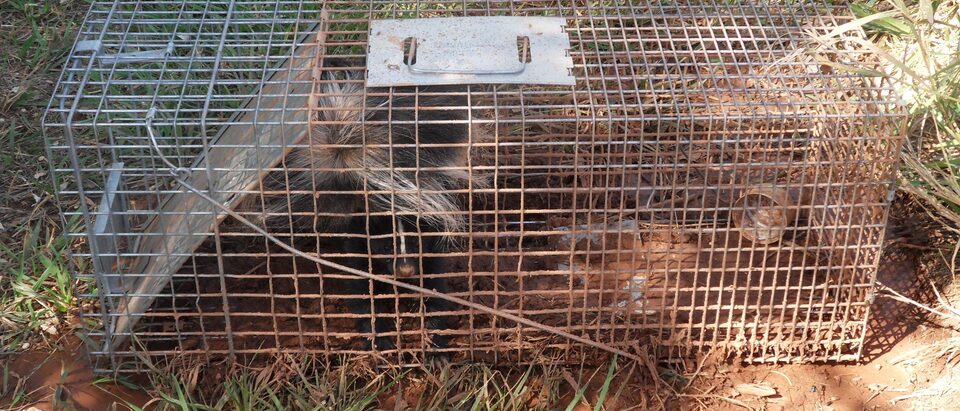
Doing it yourself is cheaper in money and more expensive in time and risk. You will need a large cage trap and some bait, plus materials to seal the den after. Before you start, check your state and local laws, because trapping and relocating wildlife is restricted or banned in a lot of places.
The bigger cost is the risk: skunks spray when threatened, handling one is how you get sprayed or bitten, and if you seal the den wrong you leave a litter behind. A lot of people try DIY once and then pay a pro anyway.
Professional Removal
A professional handles inspection, trapping, removal, and the sealing that stops a repeat. Expect the trapping and removal to be the main cost, with exclusion as an added amount depending on how many entry points there are.
Most good companies offer a written warranty on their exclusion work, meaning they come back at no charge if a skunk gets back in through the same spot. That warranty is worth paying for.
Exclusion and Prevention
Exclusion is the permanent fix, and it is usually the most expensive line item because it is the most labor. It means burying hardware cloth along the deck or foundation so nothing can dig under, capping vents, and sealing gaps.
The cost varies with how much perimeter you have to cover and how hard it is to reach. A small deck is quick; a whole foundation with multiple openings is a real project.
Odor Cleanup
If a skunk has sprayed in or near the house, cleanup is its own cost. Spray outside often fades on its own in a few weeks. Spray that gets into a crawl space, attic, or an interior room needs active treatment, and professional deodorizing or ozone treatment is more expensive the worse and the more confined the contamination is.
The DIY hydrogen peroxide and baking soda route works on some surfaces and is much cheaper, but it does not do much on porous material like drywall or insulation. If the smell survives a DIY attempt, that is when you call someone.
DIY vs Professional: My Take
If it is a single skunk in an accessible spot, you have the time, and you have checked the law, DIY can work. The risk is an incomplete exclusion that just buys you another skunk next season.
For a maternal den, multiple skunks, a tough access point, or a spray inside the house, pay a professional. One clean job that solves it permanently usually beats three DIY attempts that do not seal the hole.
Frequently Asked Questions
Usually not the removal itself. Some policies cover damage wildlife causes, like chewed wiring or structural damage, but the trapping and removal is typically excluded. Check your policy or call your agent.
Three, from licensed wildlife companies, and compare what is included, not just the total. The cheapest quote often leaves out the exclusion, which means the skunks come back.
Up front, yes. You are buying a trap and bait instead of labor. But factor in the risk of a spray, a bite, catching the neighbor’s cat, and getting the relocation law wrong. Cheap gets expensive fast.
Mostly a matter of days: a day or two of trapping, then the exclusion work once the skunk is out. The exact timeline depends on how many entry points and whether there is a litter to account for.
Some do, some only do bugs and rodents. Ask specifically whether they handle skunks and whether they are licensed for wildlife, not just insects.
The exclusion. Trapping a single skunk is relatively quick. Burying hardware cloth around a deck or foundation and sealing every entry point is where the labor and materials pile up, but it is also the part that actually ends the problem.