foundation damage groundhog

Groundhog Damage to Foundations: Identification and Repair (2026)

Groundhog Damage to Foundations: Identification and Repair (2026)

Groundhogs are powerful diggers. A single groundhog (Marmota monax) can excavate a burrow system that extends 30 to 50 feet with multiple chambers and entrances. When these burrows are located near a building foundation, the structural consequences can be serious. Understanding how groundhog (Marmota monax) burrows affect foundations, how to identify the damage, and how to repair it is essential for protecting your home.

Groundhog damage to foundations is often mistaken for water damage, settlement cracks, or other structural issues. The key difference is the presence of burrow entrances, excavated soil mounds, and tunnel systems near the foundation. Early detection and repair can prevent expensive structural repairs and keep your property safe.

Key Takeaways

  • Structural risk: Groundhog burrows can undermine foundation footings, causing settlement and cracking.
  • Water damage: Burrows can redirect water toward foundations, leading to hydrostatic pressure and basement flooding.
  • Identification signs: Look for soil mounds, burrow entrances within 10 feet of the foundation, and fresh dirt near the base of walls.
  • Repair steps: Remove the groundhog (Marmota monax) first, then excavate, backfill, compact, and install exclusion barriers.
  • Prevention: Physical barriers like gravel trenches and galvanized wire mesh are the most effective long-term solutions.

How Groundhog Burrows Damage Foundations

Groundhogs build extensive burrow systems that can extend 30 to 50 feet in length and reach depths of 4 to 5 feet. The burrow system includes a main entrance, one or more escape exits, nesting chambers, and latrine chambers. When these burrows are excavated near a foundation, they can displace the soil that supports the footing.

The primary mechanism of damage is soil displacement. A groundhog (Marmota monax) digging a burrow removes soil from beneath or beside the foundation footing. This creates voids that can cause the foundation to settle unevenly. The result is cracking in the foundation walls, floors, and even the superstructure of the building. Cracks may appear in drywall, brick veneer, or concrete slabs.

Water damage is a secondary but equally serious concern. Groundhog burrows create channels that direct rainwater toward the foundation. Instead of draining away from the house, water flows into the burrow system and pools against the foundation wall. This increases hydrostatic pressure, which can push water through foundation cracks and into basements or crawlspaces.

Over time, water flowing through burrows can erode the soil further, enlarging the voids and worsening the structural damage. In severe cases, the burrow system can collapse, creating a sinkhole near the foundation. This is a serious safety hazard that requires immediate professional attention.

Identifying Groundhog Damage to Foundations

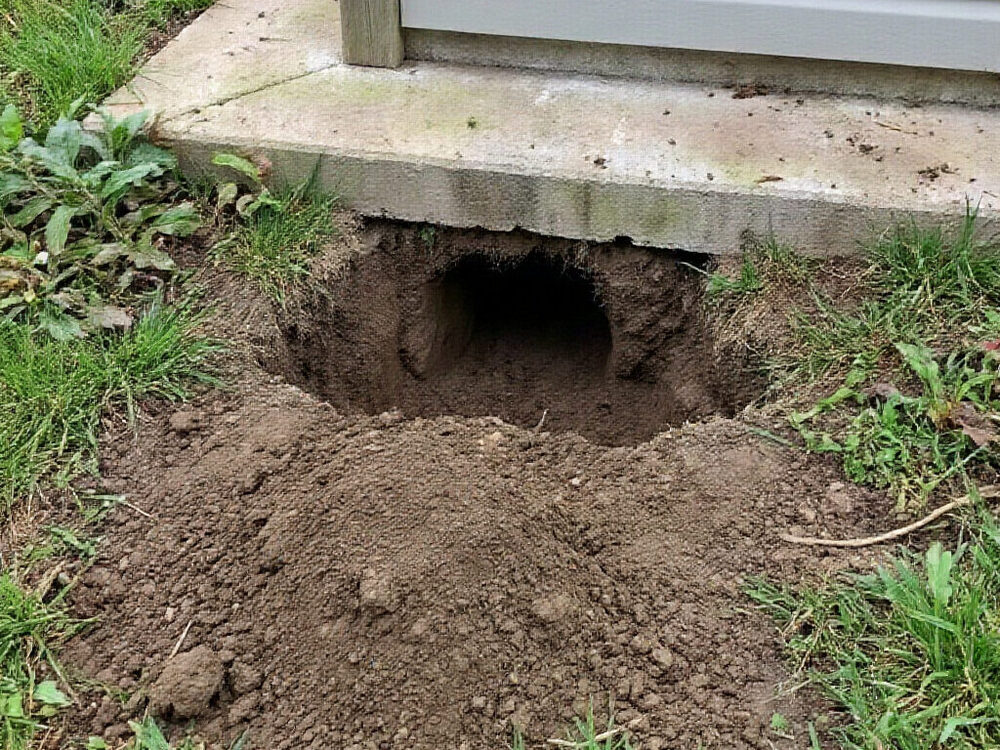
The first sign of groundhog (Marmota monax) activity near a foundation is the presence of soil mounds. Groundhogs push excavated dirt out of their burrow entrances, creating distinctive fan-shaped mounds of loose soil. These mounds are typically found within 10 to 15 feet of the burrow entrance. If the mounds are within 10 feet of your foundation wall, the burrow system may be extending under the building.

Look for burrow entrances themselves. Groundhog burrows have a main entrance that is roughly 10 to 12 inches in diameter, shaped like a half-circle or horseshoe. The entrance is usually marked by a large soil mound. Escape exits are smaller, about 6 to 8 inches in diameter, and may not have a soil mound. These exits are often located closer to the foundation wall.

Check for foundation cracks that appear suddenly or worsen over time. Groundhog-related cracks are often horizontal or stair-step in pattern, following the mortar joints in block foundations. In poured concrete foundations, the cracks may be vertical or diagonal. If the cracks are accompanied by soil mounds or burrow entrances nearby, groundhog (Marmota monax)s are likely the cause.

Look for signs of water intrusion in the basement or crawlspace that coincide with groundhog (Marmota monax) activity. If you notice water seeping through foundation walls after rain, and there are groundhog (Marmota monax) burrows near the foundation, the burrows may be directing water toward the building. Check for damp spots, efflorescence, or musty odors that are new or worsening.

Warning: Do not attempt to fill in groundhog (Marmota monax) burrows near a foundation without first removing the animal. Trapping a groundhog (Marmota monax) inside its burrow can cause it to dig deeper, worsening the damage. It can also result in a dead animal under your foundation, which creates odor and sanitation issues.
<!– wp:heading –>

Inspecting the Damage

A thorough inspection is the first step in planning repairs. Start by measuring the distance between burrow entrances and the foundation wall. Burrows within 10 feet are a significant concern. Burrows within 5 feet require immediate attention. Use a tape measure and mark the locations on a diagram of your property.

Check the foundation for cracks using a flashlight. Look for cracks that are wider than 1/8 inch, as these indicate structural movement. Use a crack monitor or a simple piece of tape to track whether the crack is widening over time. Mark the crack with a pencil and check it weekly. If the crack continues to widen, the burrow system is likely still active.

Inspect the interior of the basement or crawlspace for signs of water damage, mold, or structural movement. Look for bowing walls, floor heaving, or gaps between the wall and floor. These signs indicate that the foundation has moved and professional repair may be needed. Take photos of all damage for documentation and insurance purposes.

Repairing Groundhog Damage to Foundations

Before any repair work, the groundhog (Marmota monax) must be removed. Use live traps baited with fresh vegetables, cantaloupe, or peanut butter. Place the trap near the burrow entrance and check it twice daily. Once the groundhog (Marmota monax) is trapped, follow your state’s laws for relocation or euthanasia. Do not attempt repairs until you are certain the burrow is empty.

After the groundhog (Marmota monax) is removed, excavate the burrow system. Dig down to expose the tunnels and remove all loose soil. The excavation should extend at least 12 inches beyond the burrow walls on all sides. If the burrow runs under the foundation, you may need to consult a structural engineer to determine the best approach for filling the void.

Backfill the excavated area with compacted soil. Use a hand tamper or mechanical plate compactor to compact the soil in 6-inch lifts. The compacted soil should be slightly mounded to allow for settling. For burrows that extend under the foundation, pressure grouting may be needed to fill the void. This involves injecting a cement-based grout into the void through holes drilled in the foundation.

Install an exclusion barrier after backfilling. Dig a trench 12 to 18 inches deep around the foundation and install 1/2 inch galvanized hardware cloth (1/2 inch galvanized mesh) or welded wire mesh. The mesh should extend 6 inches above ground and be bent outward at a 90-degree angle at the bottom to prevent groundhog (Marmota monax)s from digging under it. Backfill the trench and compact the soil.

Preventing Future Groundhog Damage

The best way to prevent groundhog (Marmota monax) damage to foundations is to make the area around the foundation unattractive to burrowing. Keep vegetation trimmed, remove brush piles, and eliminate food sources like fallen fruit and garden vegetables. Groundhogs prefer to dig in areas with cover, so open, well-maintained areas are less attractive.

Install a gravel barrier around the foundation. A trench filled with 12 to 18 inches of 1 to 2 inch gravel creates a physical barrier that groundhog (Marmota monax)s cannot dig through. The gravel should extend at least 3 feet from the foundation wall. This is a permanent solution that also improves drainage and reduces water damage risk.

Regular inspections are important. Walk the perimeter of your foundation monthly during the active season, checking for fresh soil mounds, new burrow entrances, or signs of digging. Early detection allows you to address a groundhog (Marmota monax) problem before the burrow system reaches the foundation.

Frequently Asked Questions

Can a groundhog (Marmota monax) burrow collapse a foundation?

It is rare for a groundhog (Marmota monax) burrow to cause a complete foundation collapse, but the burrow can cause significant structural damage. The soil displacement can lead to uneven settlement, cracking, and water intrusion. In severe cases, the burrow system can collapse and create a sinkhole near the foundation. Early intervention prevents most serious damage.

How deep do groundhog (Marmota monax) burrows go near foundations?

Groundhog burrows typically reach depths of 4 to 5 feet. Near foundations, the burrows may extend deeper if the groundhog (Marmota monax) is seeking stable soil. The burrow depth is determined by the frost line and soil conditions. Groundhogs dig below the frost line to maintain a stable temperature in the burrow chamber.

How do I know if a groundhog (Marmota monax) is under my house?

Signs include burrow entrances within 10 feet of the foundation, fresh soil mounds near the base of the wall, new foundation cracks, water intrusion in the basement, and the sound of scratching or digging under the floor. You may also see groundhog (Marmota monax) tracks or droppings near the foundation.

Should I fill in groundhog (Marmota monax) holes near my foundation?

Do not fill in groundhog (Marmota monax) holes near your foundation until the animal has been removed. Filling an active burrow can trap the groundhog (Marmota monax) inside, causing it to dig deeper and potentially damage the foundation further. It can also result in a dead animal under the building. Trap and remove the groundhog (Marmota monax) first, then fill the burrow.

Related Resources

Why Trust Us

WildAnimalsCentral provides reliable, research-based wildlife control information. Our content is developed with input from structural engineers, wildlife biologists, and licensed pest control professionals. We reference university extension publications, building code standards, and industry best practices. Every article is reviewed for accuracy and practical application.