
Snake shed skin: what it tells you and what it cannot tell you
A shed skin is the one snake sign you can pick up with your bare hands, and it carries more information than most people expect: the scale rows, the keels, the belly scutes, the pattern, and on a rattlesnake the rattle. Here is what I read off a shed, and the honest point where it stops being able to name a species.
- A shed means the snake is alive and was there recently. Not dead, not gone: a snake sheds in one piece and moves on.
- The shed keeps the pattern. Color is in the skin, so a shed in the grass can be matched to the animal that left it.
- The rattle is proof. A rattlesnake sheds its rattle along with the rest of the skin and adds a segment, so a shed with a rattle attached can only be a rattlesnake.
- Keeled scales do not mean venomous. Garter snakes and rat snakes have keeled scales too. Same trap as the triangular head.
- A shed indoors is the important one. It means the animal got in. Look for the gap in the same week, before you decide it left.
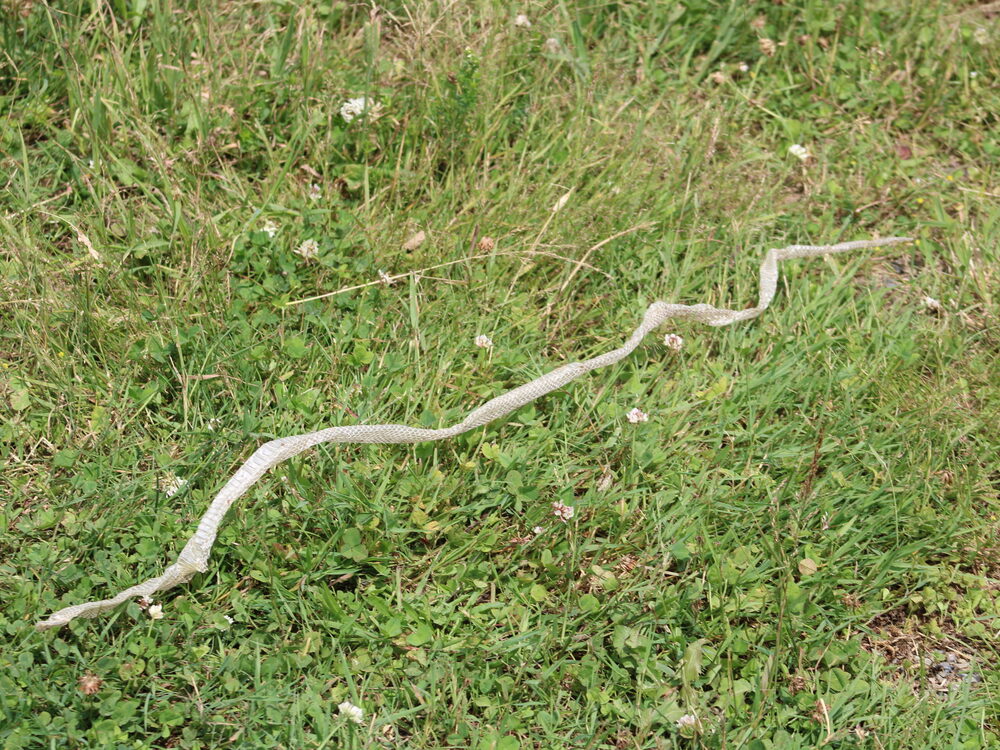
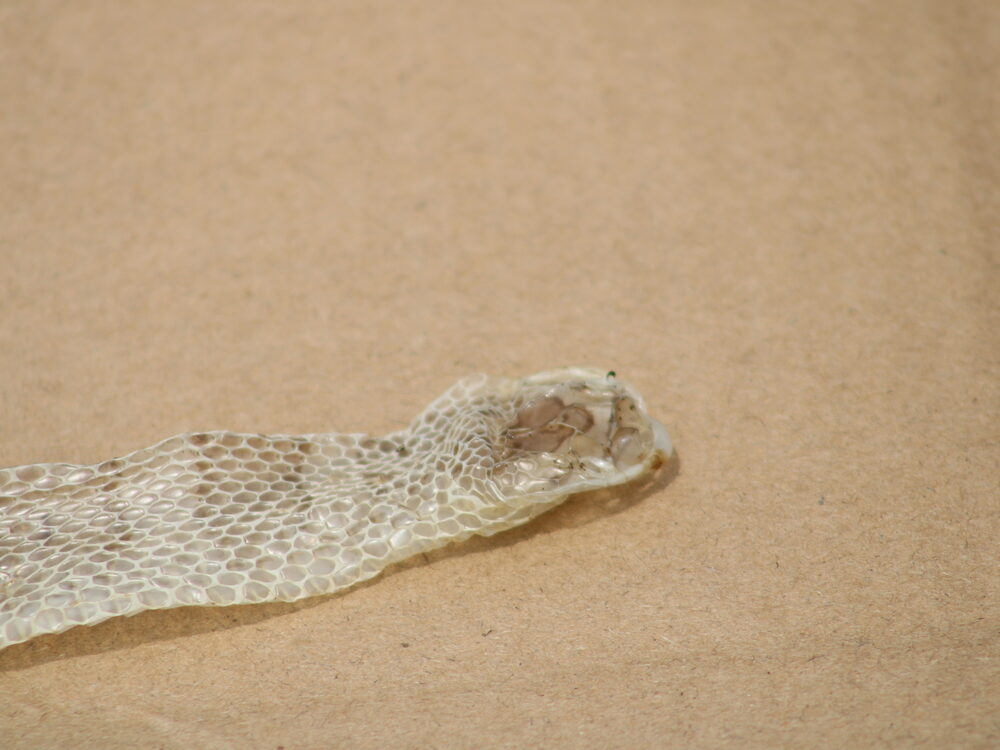
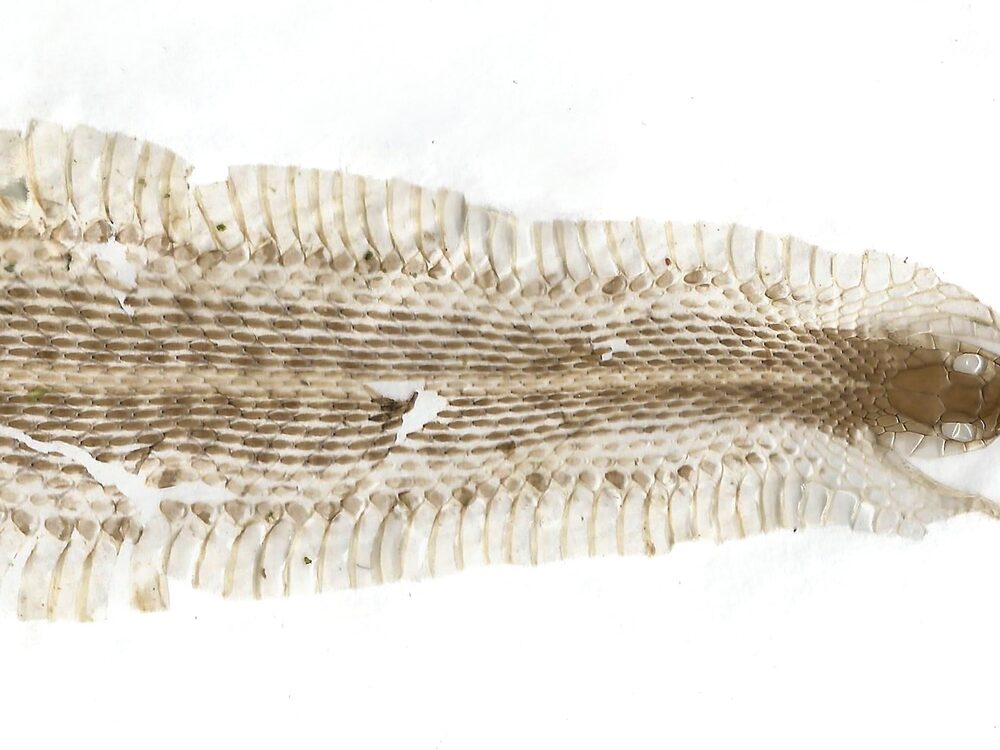
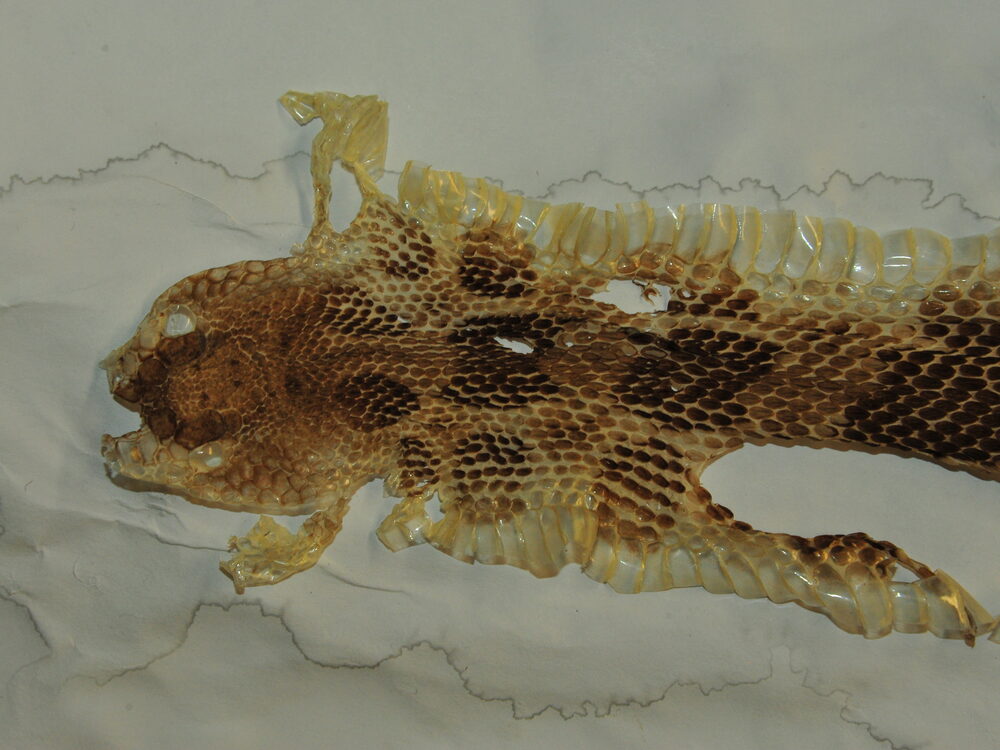
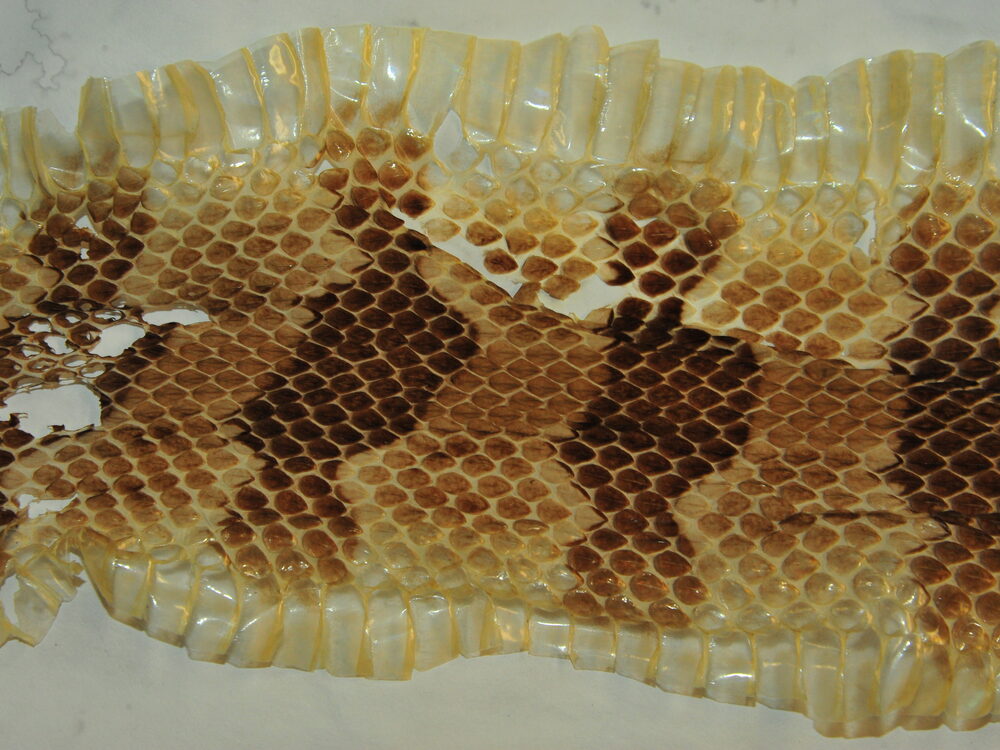
Why snakes shed, and how often
A snake grows, its skin does not, so it has to be replaced. The animal loosens the old layer from the inside, the eyes go cloudy and blue for a few days and the snake hides while it happens, then the skin comes off in one piece starting at the head. A healthy adult sheds roughly three to six times during the warm months, and a young snake still growing does it every few weeks.
When the shed goes wrong, the skin comes off in patches and leaves pieces stuck over the eyes or the tail tip, which usually means the snake could not find enough humidity. That is a normal thing to see at the end of a dry spring, and it is one of the reasons a water dish in a shaded corner of a garden gets used by more than the birds.
Where sheds turn up
Snakes rub against something rough to start the process, so the shed is almost always caught on the object that did the work: bark, a rock edge, a woodpile, a fence rail, the corner of a shed, the base of a chimney, a stack of flower pots, or a rough wall where the siding meets the foundation. Finding one on open grass is common too, because after the shed the animal simply crawls away and leaves it where it fell.
Two places matter more than the rest. A shed outdoors in a garden bed is ordinary and tells you the yard is working the way a yard should. A shed inside a house, a garage or an attic is a different message, and I treat it as the start of an entry-point search rather than as a curiosity.
What you can actually read off a shed
- The pattern. The dorsal markings are still there, so a blotched shed and a striped shed are already two different animals, and you can compare what you have with the species in my snake identification chart.
- The scales in the middle of the body. Count the rows across the widest part. Work from the belly edge on one side to the belly edge on the other, in groups of two or three, because on a thin skin a straight count goes wrong. The number narrows the candidates.
- Keeled or smooth. A keel is a ridge running down the middle of each scale, and you can feel it with a fingertip or see it with a light held at a low angle. It separates groups, not danger: several harmless species are heavily keeled.
- The belly scales. One wide scale across the full width of the belly for every rib, with the narrow ones under the tail behind the vent. This is the easiest part of a shed to read, and the count is a real field mark.
- The scales under the tail. A single row widens the odds of a pit viper, a divided row widens the odds of a harmless species, but the overlap between groups is real, so I never call a species on this alone.
- The rattle. If the shed ends in a rattle, the answer is settled without any counting.
The limit is worth repeating, because a shed is where overconfidence starts. Scale counts and keels put a snake in a group. The pattern and the location put it in a shorter list. Only a few cases can be closed from a shed alone, and the rattle is the cleanest of them.
If you found a shed indoors
- Judge the age of the shed. Flexible and whole means days. Brittle and torn means it has been there longer, and the animal has had more time to leave.
- Search the rooms next to it first, along walls and behind appliances, and check the ceiling cavity above the room if the shed was high up.
- Close the route, not just the room. The snake came in through a gap: under a door, around a pipe, through a crawlspace hatch or a vent with no screen.
- Skip the home remedies. Mothballs and snake repellents do not work, and the reason is worth reading once: why mothballs are not effective for snakes.
- Call a licensed operator if you would rather not search, especially with small children or pets in the house, and remember that some native snakes are protected in Florida and North Carolina.
More signs in the same series: the animal tracks chart and the animal droppings chart, both built the same way, one photo per species with the measurements and the marks that settle it. If you would rather answer two questions and get the shortlist, the what did I find tool does that.
To a group, often. To a species, only sometimes. A clean, unbroken shed keeps the dorsal pattern and the scale detail, so you can count the rows of scales around the middle of the body, check whether the scales are keeled or smooth, and look at the scales under the tail. The rattle settles a rattlesnake on its own. Past that, two harmless species can share a pattern and a scale count, so a shed on its own is not proof of a species.
No, it means the opposite. A snake sheds in one piece and leaves the skin behind, so a fresh shed is a record that the animal was in that spot recently, usually within a day or two. In dry cover a shed can last a few weeks before it crumbles, and in wet grass it falls apart in days, which is why you can only ever treat a shed as recent, not current.
No. Shedding is normal growth, not a death. A healthy adult sheds roughly three to six times a year during the warm months, and a growing youngster sheds every few weeks. The only time it goes wrong is when the humidity is too low and the skin comes off in pieces, which leaves patches stuck over the eyes or the tail tip.
Hold the shed up to a light, find the middle of the body and count across the widest part, from the belly edge on one side to the belly edge on the other. Work in groups of two or three by running a fingertip along the rows, because counting one by one on a thin skin is where the mistakes come from. The count only means something on a clean midbody section, well away from the neck and the tail.
A shed has no venom in it and cannot bite. It is keratin, the same material as your fingernails. The only sensible precaution is washing your hands afterwards, because the skin carries whatever bacteria were on the snake, and reptiles can carry salmonella.
Look at the condition first. If it is still in one piece and flexible, the snake was there within days and may still be inside. Check the obvious routes: a gap under a door, a pipe penetration, a crawlspace hatch, a gap in a wall where the siding meets the foundation. Do not use mothballs, they do not work and the label restrictions make them illegal for this use. If you would rather not look, a licensed wildlife operator will search the space and close the entry.