
Bird repellents work by scent, movement, and the illusion of a predator, and the best approach combines more than one. Birds are persistent, so a layered deterrent is what actually keeps them off ledges, signs, and garden areas. Here are the repellents worth using.
- Visual deterrents like owl decoys and reflective tape are the most reliable for roosting birds.
- Scent sprays work for targeted surfaces like ledges and signs.
- Ultrasonic devices have mixed results and work best in small areas.
- Combine methods, since birds habituate to a single deterrent.
Quick Comparison
| Product | Type | Best For | Buy |
|---|---|---|---|
| NatureStop Bird Repellent Spray | Spray | Best Spray | Check price |
| Colton’s Naturals Bird Spray | Spray | Best Natural | Check price |
| LNYUHAD Ultrasonic 2-Pack | Ultrasonic | Best Ultrasonic | Check price |
| LNYUHAD Solar Ultrasonic | Ultrasonic | Best Solar | Check price |
| Dalen Great Horned Owl Decoy | Decoy | Best Decoy | Check price |
| Hausse 2-Pack Owl Decoy | Decoy | Best Decoy Value | Check price |
Best Spray: NatureStop Bird Repellent Spray
 Best Spray
- Type
- Spray
- Target
- Roosting birds
- Size
- 16 oz
- Reapply
- As scent fades
NatureStop’s bird repellent spray uses a scent birds avoid, applied to the ledges, signs, and surfaces where they roost. The 16-ounce spray is the right size for targeted application.
A spray is the most direct way to treat a specific roosting spot, though it needs reapplication as the scent fades.
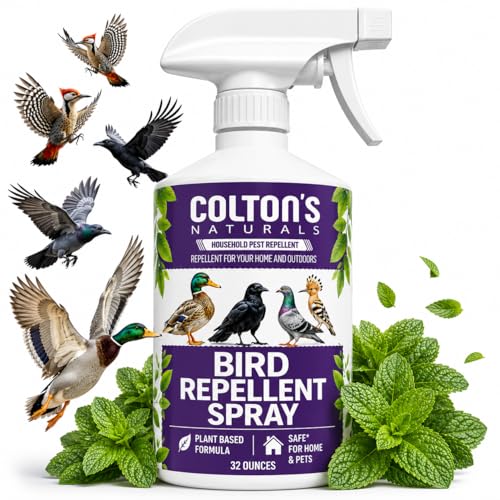
Best Natural: Colton’s Naturals Bird Repellent Spray
 Best Natural
- Type
- Spray
- Target
- Roosting birds
- Size
- 32 oz
- Active
- Natural
Colton’s Naturals uses a natural scent and taste birds avoid, applied to the surfaces where they roost. The 32-ounce bottle covers a larger area than smaller sprays.
The natural formula is the gentler choice for households with pets and children.
Best Ultrasonic: LNYUHAD Ultrasonic 2-Pack
 Best Ultrasonic
- Type
- Ultrasonic (2-pack)
- Target
- Birds
- Coverage
- Small areas
- Power
- Plug-in
The LNYUHAD ultrasonic devices emit high-frequency sound birds find irritating, in a two-pack that covers two areas. Ultrasonic works best in small, enclosed spaces where the sound does not dissipate.
Be realistic about ultrasonic: results are mixed, and it is best as a supplement to visual deterrents rather than a standalone fix.
Best Solar: LNYUHAD Solar Ultrasonic
 Best Solar
- Type
- Solar ultrasonic
- Target
- Birds
- Power
- Solar
- Coverage
- Outdoor, small areas
This solar ultrasonic device runs without wiring, making it the low-maintenance option for outdoor bird control. The solar panel keeps it charged, and it emits sound birds avoid.
Like all ultrasonic units, it works best in a confined area and as part of a layered approach.
Best Decoy: Dalen Great Horned Owl Decoy
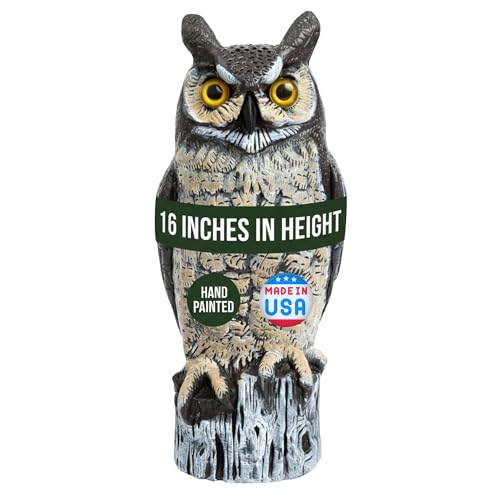 Best Decoy
- Type
- Owl decoy
- Target
- Roosting birds
- Mechanism
- Predator cue
- Placement
- Move periodically
The Dalen owl decoy is the classic visual bird deterrent, using the silhouette of a predator birds avoid. The lifelike decoy is placed where birds roost.
Move the decoy periodically, since birds learn to ignore a stationary decoy over time.
Best Decoy Value: Hausse 2-Pack Owl Decoy
 Best Decoy Value
- Type
- Owl decoy (2-pack)
- Target
- Roosting birds
- Mechanism
- Predator cue plus movement
- Placement
- Two areas
The Hausse two-pack of owl decoys gives you two predator silhouettes to cover two roosting areas at once. The rotating head design adds movement that birds find threatening.
Two decoys are better than one for a house with birds on multiple ledges or signs.
How to Choose a Bird Repellent
Identify the Bird
Different birds respond to different deterrents. Roosting pigeons respond to spikes and decoys, while smaller perching birds may need spray or ultrasonic. Know what you are dealing with.
Combine Methods
Birds habituate to a single deterrent, so the strongest approach combines a visual deterrent with a scent spray or ultrasonic. Rotate and reposition periodically.
Legal Note
Native songbirds are protected under the Migratory Bird Treaty Act, so removal of active nests is restricted. Pigeons, starlings, and sparrows are not protected, making proofing legal and straightforward.
Frequently Asked Questions
Yes, when combined and repositioned. Visual deterrents like decoys and reflective tape are the most reliable, and scent sprays work on targeted surfaces. No single method is permanent.
The combination of a predator decoy, reflective surfaces, and removing roosting spots. Birds habituate to a single method, so rotate and combine for the best results.
Results are mixed. They work best in small, enclosed spaces, and birds can habituate to a fixed frequency. Use them as a supplement to visual deterrents.
Scent sprays should be kept away from pets until dry, and ultrasonic devices are inaudible to most pets. Always follow the label.
Native songbirds are protected under the Migratory Bird Treaty Act, so active nests cannot be removed. Pigeons, starlings, and sparrows are not protected and can be proofed freely.