Groundhog Proof Fencing: Installation Guide (2026)
Fencing is one of the most reliable long-term solutions for groundhog (Marmota monax) control. Unlike trapping, which removes individual animals, fencing creates a permanent barrier that prevents groundhog (Marmota monax)s from entering your garden, yard, or property. However, groundhog (Marmota monax) proof fencing is different from standard garden fencing. Groundhogs are strong diggers and climbers, and a regular fence will not stop them.
A properly installed groundhog (Marmota monax) fence uses specific materials, dimensions, and installation techniques to block both digging and climbing. This guide covers everything you need to know about selecting, installing, and maintaining groundhog (Marmota monax) proof fencing, including the best materials, the correct dimensions, and the installation methods that work.
Key Takeaways
- Underground barrier: Groundhog fencing must extend 12 to 18 inches below ground to prevent digging.
- Outward bend: The bottom of the fence should be bent outward at a 90-degree angle to block burrowing attempts.
- Height requirement: The fence should be at least 3 to 4 feet tall, with an optional top overhang for climbing.
- Mesh size: Use 1/2 inch or 1 inch galvanized hardware cloth (1/2 inch galvanized mesh) or welded wire mesh.
- Electric option: A low-voltage electric wire at the bottom of the fence adds additional deterrence.
What Makes a Fence Groundhog Proof?
Groundhogs are powerful diggers. A groundhog (Marmota monax) can dig a tunnel under a standard fence in a matter of hours. To stop them, the fence must extend below ground and include an outward-facing barrier. The standard design uses a trench 12 to 18 inches deep, with the fence buried in the trench and the bottom 6 inches bent outward at a 90-degree angle away from the protected area.
The outward bend, often called an apron or L-footer, is the most important feature of a groundhog (Marmota monax) fence. When the groundhog (Marmota monax) tries to dig under the fence, it encounters the buried mesh. The outward bend directs the groundhog (Marmota monax) away from the fence, discouraging further digging. Without this bend, a groundhog (Marmota monax) can simply dig straight down and tunnel under the fence.
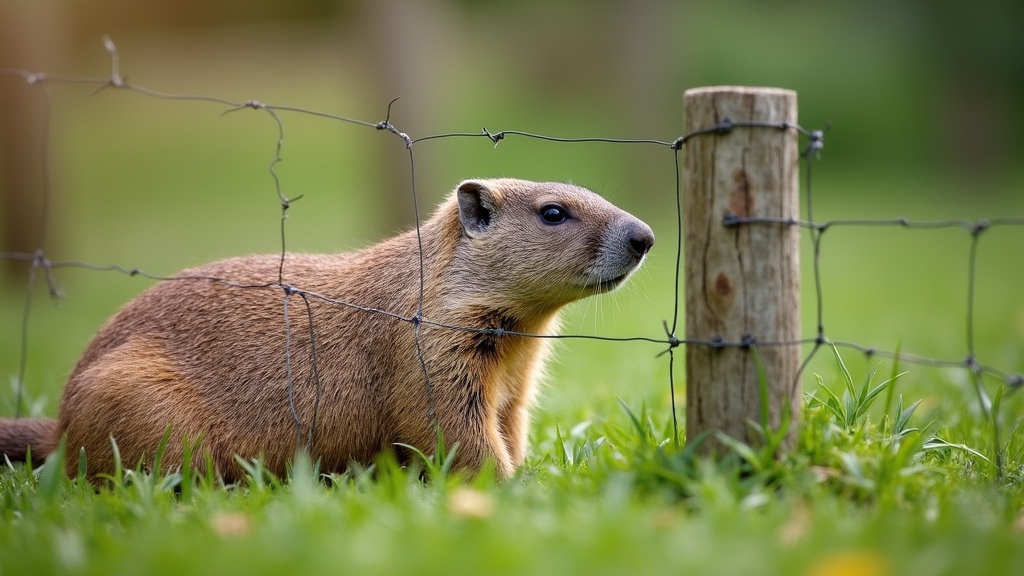
Groundhogs can also climb. They are not as agile as squirrels, but they can climb wire mesh, wooden fences, and chain link fences if the mesh is large enough. A fence that is 3 to 4 feet tall is usually sufficient to prevent climbing. For persistent groundhog (Marmota monax)s, add an outward-facing overhang at the top of the fence, similar to a coyote roller, to prevent climbing over.
Choosing the Right Materials
The best material for groundhog (Marmota monax) proof fencing is galvanized hardware cloth (1/2 inch galvanized mesh) with 1/2 inch mesh. This material is strong, rust-resistant, and the small mesh size prevents groundhog (Marmota monax)s from squeezing through or climbing. Hardware cloth is available in rolls and can be cut with wire cutters. It is more expensive than chicken wire but much more durable and effective.
Welded wire mesh with 1 inch by 2 inch openings is another option. This material is less expensive than hardware cloth (1/2 inch galvanized mesh) and is still effective for groundhog (Marmota monax)s. The 1×2 inch mesh is too small for a groundhog (Marmota monax) to squeeze through. However, younger groundhog (Marmota monax)s may be able to fit through the 2 inch dimension. Use hardware cloth (1/2 inch galvanized mesh) if you want maximum protection.
Do not use chicken wire for groundhog (Marmota monax) fencing. Chicken wire has large openings that groundhog (Marmota monax)s can push through or squeeze through. The wire is also thin and easy for groundhog (Marmota monax)s to chew through. Chicken wire is designed for containing chickens, not excluding determined wildlife. It will not stop a groundhog (Marmota monax).
Use galvanized or coated wire to prevent rust. Uncoated wire will rust within a few years, especially if buried in the ground. Galvanized wire has a zinc coating that resists corrosion. Vinyl-coated wire provides additional protection. The extra cost is worth it for the longevity of the fence. A well-constructed groundhog (Marmota monax) fence can last 10 to 15 years.
Step by Step Installation Guide
Step 1: Plan the Fence Layout
Measure the area you want to protect. Mark the fence line with stakes and string. The fence should enclose the entire area, including the gate. Measure the total linear footage and order enough materials. Allow extra for the underground portion and the outward bend. The total height of the fence material should be 4 to 5 feet: 12 to 18 inches for the underground section, plus 3 to 4 feet above ground.
Step 2: Dig the Trench
Dig a trench along the fence line that is 12 to 18 inches deep and 6 to 8 inches wide. The trench should be straight and even. Use a shovel or a trenching tool. For long stretches, a mechanical trencher can save time. The trench depth should be consistent along the entire length. Remove rocks and roots from the trench that could interfere with the fence installation.
Step 3: Install the Fence Posts
Install fence posts every 6 to 8 feet along the fence line. Use treated wood posts or metal T-posts. The posts should be driven into the ground 2 to 3 feet deep, depending on soil conditions. Attach the mesh to the posts using fence staples or wire ties. The mesh should be pulled tight and secured at each post. Leave the bottom 12 to 18 inches of mesh loose for the underground portion.
Step 4: Bend and Bury the Mesh
Bend the bottom 6 inches of the mesh outward at a 90-degree angle, away from the protected area. This creates the L-footer that prevents groundhog (Marmota monax)s from digging under the fence. Place the mesh in the trench, with the bent portion lying flat on the bottom of the trench pointing outward. Backfill the trench with the excavated soil, compacting it firmly as you go.
Step 5: Secure the Top
For areas with persistent groundhog (Marmota monax) problems, add an outward-facing overhang at the top of the fence. Bend the top 6 to 12 inches of mesh outward at a 45 to 90 degree angle. This prevents groundhog (Marmota monax)s from climbing over the top. The overhang should be supported by attaching it to the fence posts or by adding a top rail.
Gate Installation and Maintenance
Gates are the weakest point in any groundhog (Marmota monax) fence. The gate must be constructed with the same mesh and underground barrier as the rest of the fence. The bottom of the gate should have a metal strip or a buried mesh panel that extends outward to prevent digging. The gate should fit tightly with no gaps at the bottom or sides. A gap of even 2 inches is enough for a groundhog (Marmota monax) to squeeze through.
Install a self-closing hinge and a latch on the gate. A gate left open is an invitation for groundhog (Marmota monax)s to enter. Self-closing hinges ensure the gate closes automatically. The latch should be secure enough that a groundhog (Marmota monax) cannot push it open. Consider adding a ground-level bar or threshold at the bottom of the gate to prevent digging under the gate.
Inspect the fence regularly. Check for gaps, holes, or damage. Look for signs of digging along the fence line. Groundhogs may test the fence by digging at the base. If you see fresh digging, reinforce the area with additional mesh or rocks. Trim vegetation that grows against the fence, as groundhog (Marmota monax)s can use plants as cover for digging.
Frequently Asked Questions
How deep should a groundhog (Marmota monax) fence be buried?
The fence should be buried 12 to 18 inches deep. The bottom 6 inches should be bent outward at a 90-degree angle away from the protected area. This L-footer configuration prevents groundhog (Marmota monax)s from digging under the fence. Without the outward bend, a groundhog (Marmota monax) can dig straight down and tunnel under the fence.
Will chicken wire stop groundhog (Marmota monax)s?
No. Chicken wire is not effective for groundhog (Marmota monax) control. The mesh openings are large enough for groundhog (Marmota monax)s to push through, and the wire is thin enough for them to chew through. Use galvanized hardware cloth (1/2 inch galvanized mesh) with 1/2 inch mesh or welded wire mesh with 1×2 inch openings for effective groundhog (Marmota monax) exclusion.
Can groundhog (Marmota monax)s climb fences?
Yes, groundhog (Marmota monax)s can climb, though they are not as agile as squirrels. They can climb wire mesh, wooden fences, and chain link fences if the mesh is large enough. A fence that is 3 to 4 feet tall is usually sufficient to prevent climbing. For persistent groundhog (Marmota monax)s, add an outward-facing overhang at the top of the fence.
How long does a groundhog (Marmota monax) fence last?
A well-constructed groundhog (Marmota monax) fence using galvanized hardware cloth (1/2 inch galvanized mesh) can last 10 to 15 years. The buried portion lasts longest because it is protected from sun exposure. The above-ground portion may need replacement sooner if it is exposed to direct sunlight. Use galvanized or vinyl-coated wire to maximize the lifespan of the fence.
Related Resources
- Groundhog Control Hub – Complete groundhog (Marmota monax) management guide.
- Groundhog Trapping Tips and Techniques – Removal methods.
- Groundhog Repellent Plants – Natural deterrents.
- DIY vs Professional Wildlife Removal – When to call an expert.
Why Trust Us
WildAnimalsCentral provides research-based wildlife control information. Our fencing recommendations are developed from university extension publications, structural engineering standards, and interviews with professional wildlife control operators. We test and verify installation techniques to ensure they are effective and practical. Every article is reviewed for accuracy and clarity.