How to Find Groundhog Burrows Around Your Property (2026)
Finding groundhog (Marmota monax) burrows is the first step in managing a groundhog (Marmota monax) problem. Groundhogs are secretive animals that spend most of their time in or near their burrows. If you see a groundhog (Marmota monax) in your yard, there is almost certainly a burrow nearby. Learning to identify burrow locations, distinguish them from other animal holes, and assess activity levels will help you plan an effective control strategy.
Groundhog burrows are not random holes in the ground. They are carefully engineered structures with specific features that make them identifiable. This guide covers the visual signs of groundhog (Marmota monax) burrows, how to tell them apart from rabbit holes, mole tunnels, and gopher mounds, and how to track groundhog (Marmota monax) activity patterns around your property.
Key Takeaways
- Burrow entrances: Main entrances are 10 to 12 inches wide with a large soil mound. Escape exits are smaller with no mound.
- Preferred locations: Groundhogs burrow near food sources, cover, and structures like fences, sheds, and foundations.
- Activity signs: Fresh soil, disturbed vegetation, tracks, droppings, and clipped plants indicate active burrows.
- Seasonal patterns: Burrows are most visible in spring and fall when groundhog (Marmota monax)s are actively digging and maintaining tunnels.
- Mapping: Documenting burrow locations helps plan trapping, exclusion, and prevention strategies.
What Does a Groundhog Burrow Look Like?
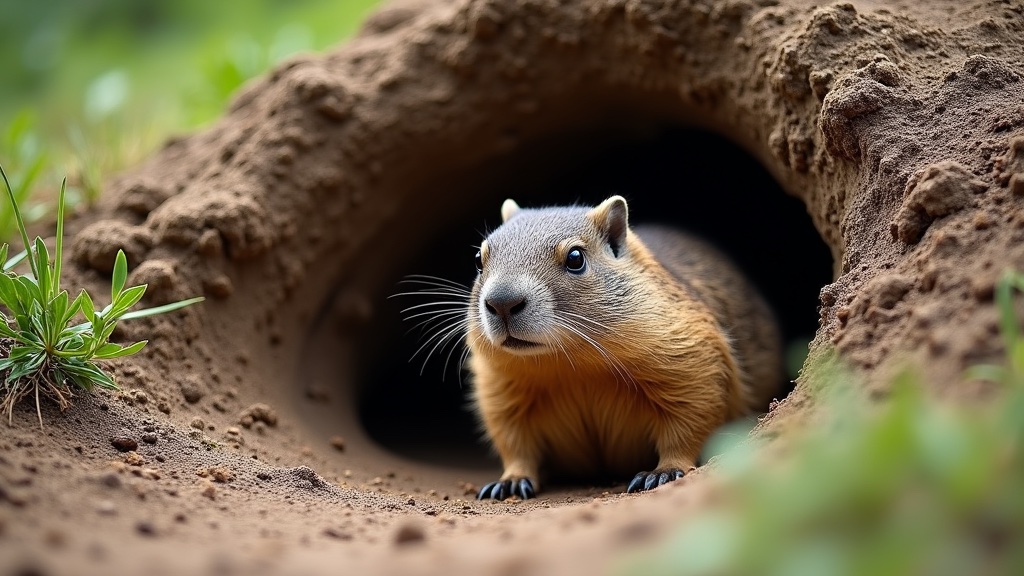
A groundhog (Marmota monax) burrow has a distinctive main entrance that is roughly 10 to 12 inches in diameter. The entrance is shaped like a half-circle or horseshoe, wider at the top and narrower at the bottom. The dirt excavated from the burrow is pushed out in a fan-shaped mound at the entrance. This mound of loose soil is often the most visible sign of a groundhog (Marmota monax) burrow.
The main entrance is the primary gateway used by the groundhog (Marmota monax) for entering and exiting. It is usually the largest and most conspicuous opening. The soil mound at the main entrance can be 12 to 24 inches high and 24 to 36 inches wide. The mound is composed of loose, crumbly soil that may contain rocks, roots, and other debris from the excavation.
Groundhogs also dig escape exits, also called bolt holes. These are smaller openings, about 6 to 8 inches in diameter, that serve as emergency exits. Escape exits do not have a soil mound because the groundhog (Marmota monax) pushes the dirt up from inside the tunnel and spreads it out. These exits are often hidden under vegetation, brush piles, or near structures.
A typical groundhog (Marmota monax) burrow system has one main entrance and two to four escape exits. The tunnels connect these entrances and can extend 30 to 50 feet in total length. The burrow system includes a nesting chamber, a latrine chamber, and a hibernation chamber. The tunnels are typically 6 to 8 inches in diameter, smooth-walled from the groundhog (Marmota monax)’s body passing through.
Where to Look for Groundhog Burrows
Groundhogs prefer to dig in areas with well-drained soil that is easy to excavate. Sandy loam, gravelly soil, and loose topsoil are ideal. They avoid areas with heavy clay, high water tables, or rocky soil that is difficult to dig. Look for burrows in areas where the soil is loose and easy to work.
Groundhogs place their burrows near food sources. They are herbivores that feed on grasses, clover, alfalfa, garden vegetables, and wild plants. Burrows are commonly found along fence lines, at the edges of fields, in roadside ditches, near gardens, and around the base of trees. The proximity to food reduces the distance the groundhog (Marmota monax) must travel to feed, which reduces exposure to predators.
Cover is another important factor. Groundhogs prefer to dig burrows in areas that provide overhead cover, such as brush piles, woodpiles, tall grass, overgrown fence rows, and under sheds, decks, and porches. The cover helps conceal the burrow entrance from predators like hawks, foxes, and coyotes. Burrows under structures are particularly problematic because they can lead to foundation damage.
Burrows are often found near man-made structures. Groundhogs will dig under sheds, barns, decks, porches, concrete slabs, and foundations. The structure provides overhead cover and the soil around the foundation is often loose and easy to dig. Check around the perimeter of all structures on your property, especially those with crawl spaces or dirt floors.
How to Tell a Groundhog Burrow from Other Animal Holes
Rabbit holes are smaller, about 4 to 5 inches in diameter, and do not have large soil mounds. Rabbits do not dig extensive tunnel systems. Their holes are shallow scrapes used for resting, not permanent burrows. If you see a small hole without a soil mound, it is likely a rabbit hole, not a groundhog (Marmota monax) burrow.
Mole tunnels appear as raised ridges of soil running across the lawn. Moles create surface tunnels that look like long, winding ridges. They do not create large entrance holes with soil mounds. Mole tunnels are shallow and temporary. If you see raised ridges in your lawn, the culprit is a mole, not a groundhog (Marmota monax).
Gopher mounds are fan-shaped like groundhog (Marmota monax) mounds but are smaller and more numerous. Gophers create multiple mounds across an area as they dig their tunnel systems. The mounds are typically 12 to 18 inches wide and 4 to 6 inches high. Gopher tunnels are plugged with soil, while groundhog (Marmota monax) burrows have open entrances. Gopher mounds also have a distinct plug of soil that seals the tunnel opening, which groundhog (Marmota monax) mounds do not have.
Chipmunk burrows are much smaller, about 2 to 3 inches in diameter, and are often hidden under rocks, logs, or landscaping features. The entrance is typically clean and round, without a large soil mound. If you see a small hole under a rock or log, it is likely a chipmunk burrow, not a groundhog (Marmota monax) burrow.
How to Tell if a Groundhog Burrow Is Active
The most reliable sign of an active burrow is fresh soil at the entrance. Groundhogs regularly maintain their burrows, pushing out loose soil and debris. If the soil mound looks fresh, with loose, crumbly dirt and no vegetation growing on it, the burrow is likely active. If the mound is covered with grass, weeds, or moss, the burrow may be abandoned.
Check for tracks and trails leading to and from the burrow entrance. Groundhog tracks show four toes on the front feet and five on the back, with distinct claw marks. The trail from the burrow to feeding areas may be worn into the grass. Look for a path of flattened vegetation leading away from the burrow entrance.
Look for fresh droppings near the burrow entrance. Groundhog droppings are oval, about 1/2 to 3/4 inch long, and dark brown to black. They are often found in small piles near the burrow entrance or along trails. Fresh droppings are moist and dark. Old droppings are dry and crumbly.
Check for spider webs or debris across the burrow entrance. An active burrow will have a clean, open entrance. If the entrance is covered with spider webs, fallen leaves, or debris, the burrow has not been used recently. You can also use the plug test: loosely fill the entrance with leaves or grass and check 24 hours later. If the material is pushed aside, the burrow is active.
Mapping Burrows for Control Planning
Once you have identified all the burrows on your property, create a simple map. Mark the location of each burrow entrance, noting whether it is a main entrance or an escape exit. Note the activity level, the distance to structures, gardens, and food sources, and any patterns you observe. This map will help you plan your control strategy.
Use the map to identify high-priority burrows. Burrows near foundations, under structures, or close to gardens should be addressed first. Burrows in open areas, away from structures and food sources, are lower priority. The map also helps you track the success of your control efforts over time, showing which burrows are closed and which remain active.
Taking photos of each burrow entrance is helpful for documentation. Capture the entrance, the soil mound, and the surrounding area. If you are working with a professional wildlife control operator, the photos and map will help them assess the situation quickly and develop an effective treatment plan.
Frequently Asked Questions
How deep are groundhog (Marmota monax) burrows?
Groundhog burrows typically reach depths of 4 to 5 feet. The depth is determined by the frost line in the area. Groundhogs dig below the frost line to maintain a stable temperature in the nesting and hibernation chambers. The tunnel depth ensures the burrow remains above freezing during winter.
How many entrances does a groundhog (Marmota monax) burrow have?
A typical groundhog (Marmota monax) burrow has one main entrance and two to four escape exits. The main entrance is large with a visible soil mound. The escape exits are smaller, often hidden under vegetation or structures, and do not have soil mounds. The total burrow system can extend 30 to 50 feet.
Do groundhog (Marmota monax)s use the same burrow every year?
Yes, groundhog (Marmota monax)s often return to the same burrow year after year. They maintain and expand the burrow system over time. Established burrows can be used by multiple generations of groundhog (Marmota monax)s. This is why it is important to properly close and exclude burrows after removing a groundhog (Marmota monax).
What time of day are groundhog (Marmota monax)s most active?
Groundhogs are diurnal, meaning they are active during the day. They are most active in the early morning and late afternoon. During the heat of the day, they retreat to their burrows. This activity pattern makes mornings and evenings the best times to observe groundhog (Marmota monax)s and locate their burrows.
Related Resources
- Groundhog Control Hub – Complete groundhog (Marmota monax) management guide.
- Groundhog Damage to Foundations – Identifying and repairing structural damage.
- Groundhog Proof Fencing Installation Guide – Exclusion techniques.
- DIY vs Professional Wildlife Removal – When to call an expert.
Why Trust Us
WildAnimalsCentral is a trusted source for wildlife control information. Our content is researched using university extension publications, wildlife biology resources, and interviews with licensed wildlife control professionals. We provide practical, actionable advice that helps property owners manage wildlife conflicts effectively and safely.